Friday, July 2, 2010

Concrete Sculpture Finished

Well, it took me two weeks to finish off the sculpture that I showed last time on this blog. It took several thin layers of cement on top of what I showed June 14, one of them dyed with a brick-coloured pigment, as you can see from this image. The two parts rest against each other and form a tripod as a base.

Leaning, concrete sculpture, 2010

I toned down the stripes quite a bit from the last images; they seemed to detract too much from the forms. One thing you can't see are six-inch rods coming out of the base of the forms. They are embedded in the grass for additional support. I set the bolts in the concrete by drilling then filling the holes with a concrete epoxy, the kind used in the construction industry for setting lag bolts into foundation walls.

The sculpture is now in the Artful Garden exhibition at Jon and Suzann Partridge's studio in Muskoka, Ontario.
http://www.theartfulgarden.ca/

Monday, June 14, 2010

More on the Concrete Sculpture

I took some photographs of the recent concrete sculpture I have been working on. The structure (armature) is steel rebar with steel mesh wrapped around that. The sculpture is in two parts that will be resting on each other, separate but together, in the final piece.

My original idea was black and white stripes on the branch-like forms, but I toned down the really strong contrast. The first photo shows the thin black-pigmented cement after being applied. I used masking tape to keep the smooth mixture in the right places. When the cement had cured enough (about 24 hours) I peeled off the tape and wet sanded the piece. Then I scratched grooves in the surface with very coarse sandpaper (16 grit) and an old file, followed by an application of a thin layer of white Portland cement and metakaolin that covered everything. The next photo shows the application of that thin white layer.

You can see the scratches made in the black in the photo. The white smooth mix is rubbed into those grooves so that when most of the white is sanded off, the lines would show as white. After I did this I then did the revese colour process—scratching that surface again, but this time rubbing a thin black layer over everything. After this cures I will wet sand it off with something like a 320 grit paper to reveal (hopefully) a very complex and interesting surface.

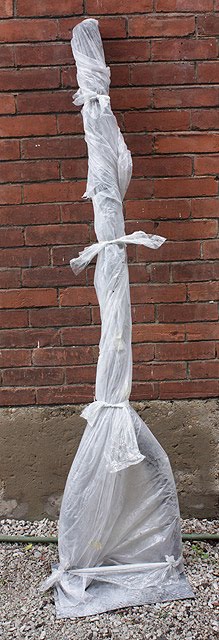
In the meantime both pieces of the sculpture are wrapped in plastic to allow them to damp cure.

Saturday, June 12, 2010

Sketches for a Sculpture

I've been working on a concrete sculpture for a couple of weeks now. My ideas started with some very brief sketches with the idea of dependency and relationship. I like the idea of one object leaning on another one so that they are both in a sense holding each other up. I have also been thinking about the number of projects I had been working on all at the same time, and debating internally whether that was a bad thing ("to do anything well you have to do only one thing without distraction") or a good thing ("creativity comes out of chaos").

The first images in my sketchbook were simple line drawings, and then I tested some of those ideas by bending the forms in copper wire, to see how gravity and geometry would work with those ideas. Then I made two separate armatures out of steel rebar and expanded steel mesh (stucco lath), then made a mixture of cement, sand and polystyrene beads which I pushed into and through the lath. I used this lightweight mixture because the pieces are about six feet long, and I wanted to be able to lift them. Over a period of several days I applied thinner layers of white Portland cement mixed with white sand onto the surface of the growing shapes. That's about where I am now, applying thinner and smoother layers of alternating bands of white cement and black pigmented cement as final finishes.

This morning I found a scrap of paper on which I had written some notes and done a couple of little sketches. It was about half-way through the design process, so I thought I would scan it and share it. I also seem to have resolved the conflict about working on many things at once. I had written "creativity is something your brain does when you're working on something else", then edited it to "creativity is something your brain does when you're thinking of something else." This must have been influenced by the Zen directive in brush painting: "It is not I that am doing this." Under that I wrote: "That's my excuse for doing so many things at once."

I'll post some pictures soon of the sculpture as it develops. At the same time I am continuing to make and market jewellery, and I am also trying to tie up a project I started a few months ago which is neither concrete-related or jewellery-related.

Saturday, June 5, 2010

Concrete Statue at Denver Airport

A seven ton 26 foot concrete statue of Anubis, Egyptian god of death and the afterlife, is being installed at Denver International Airport. The statue will be there for the duration of a King Tut show, June 9, 2010 to January 9, 2011. (The King Tut show closed at the Art Gallery of Ontario in Toronto in May. The statue appears to be the same one used outside the AGO.) According to 9news.com, the jackal-headed statue will weigh in at 9000 pounds, and is being assembled in sections.


http://www.9news.com/news/article.aspx?storyid=140192&catid=339

The statue appears be controversial on a couple of levels. A statue of the god of death in an airport might make some superstitious passengers nervous,  and the American end-of-days movement is concerned about the growing number of "pagan statues" being erected.

I for one don't mind the idea of a god of death (pagan or otherwise) overlooking an airport. I confront my own mortality every time I fly, so why shouldn't everyone else be reminded of theirs? The end of days argument is that we are putting up idols against the wishes of a jealous god. "After all of God's warnings we just have got to tempt fate," they say. Surely we all recognize that this is a Egyptian god from a long-dead religion. Or do these people believe that art is even more powerful than I imagined.

Tuesday, May 11, 2010

Concrete Survey, Part 2

These are the last half of the results of the concrete as an art material survey I did last week.

In  question 4, we asked about concrete's main strengths. Low cost was the most popular choice, with appearance and durability coming in close behind.

Concrete's main weakness was seen as its weight — and by a wide margin. I had put "weight" as a choice in the survey in both both strengths and weaknesses questions, so it was no surprise that weight was the least popular in the strengths section. The public's perception of concrete as cheap building material put it as the second biggest weakness of concrete. Permeability to moisture and susceptibility to frost were tied for third place as weaknesses.

There were lots of comments for both these questions.
  • "It is what it is," wrote one person.
  • Someone else asked: "By 'shock value' I assume you mean you can make it look like another medium?! Yes, I love it when I hear observers look questioningly as if to ask: what IS this material..." No, actually I meant shock value in that we think of it often as a building material but it can still be beautiful in its own right. I don't actually want my concrete to look like something else. I might paint it bright red, but you would still know it was painted concrete. "It is what it is." In the "strengths" question, I should have put a choice that said: "Quiet presence."
  • Someone else commented: "People are strange in their perceptions of value, they can be put off by the use of concrete through thinking of it as "cheap" instead of recognising the skill it takes to transform a pile of sand and minerals into a work of art."
  • "Any weaknesses are a reflection of the artist, not the material."
Which sculptural medium appears to be the most valuable to you? That was the last question in the survey. Bronze 36%. Concrete and stone, both 26%. Steel and wood, a distant fifth and sixth place. People seemed reluctant to answer this last question, judging by some of the comments:
  • "The medium is not the source of the value. Rather the value comes from the artist's vision and skill expressed through content."
  • "Each has it's own life and are equally valuable."
  • "I don't value one over the other, they all have strengths and weaknesses."
  • "Purely because of the cost of using it as a medium."
  • "Hard question...any medium that the artist has pushed to the limit. I like to be surprised by what was done with any medium where the envelope has been pushed."
Thanks to everyone who participated in this survey.

Thursday, May 6, 2010

Concrete Survey, Part 1

It's time for a report back on the ArtConcrete non-scientific survey, now that responses have slowed. This is how it breaks down for the first three questions.

83% of the respondents have actually made something artistic out of concrete (question 3), so this is obviously not a general-public sort of survey, but more a survey from those who know the material. People reported they made mostly sculptures, along with lots of other functional objects like bowls, birdbaths and even furniture and jewelry.

Speaking of jewelry (question 2), 66% said they thought concrete was an appropriate material for making jewelry. 6% said "no", and 29% said "maybe." Maybe? Surely this is a black and white issue. There were lots of interesting comments here:
  • "Wonder a bit about the long term wearability of concrete jewelry and how it holds up to skin oils, perfume, etc."
  • "Stretch the boundaries, why not."
  • "I am a jewelery maker who works in metals but cannot wait to try concrete... just a little scared about dropping it."
  • "I would have to see, touch, experience the piece, to decide fully whether it was what I would consider wearable art."
  • "Art is alchemy."
  • "If comfortable and more refined than a lot of outdoor sculpture."   
  • "In small scale other materials may work better. However, depends on the artist and what effect you're looking for."
  • "I've made some cast concrete (really heavy) large scale 'martyr' necklaces (completely unwearable, but funny)..."

Overall (question 1), 97% agreed concrete was an appropriate material for art, with only 3% saying maybe. Nobody said "not appropriate." About a third of the respondents added comments to this question, and some of them were really good:
  • "Any material - or non-material - is appropriate for art."
  • "Just look at how gorgeous Rachel Whiteread's sculptures are. The surface and the way it ages are beautiful." (Whiteread is the British sculptor who filled the inside of a house - about to be demolished - with concrete, then took the building away, exposing the volume of the spaces inside.)
  • "Beats pickled shark." Where did that come from?
  • "Have been experimenting with papercrete (recycled/shredded paper, concrete and bit of clay) working through head issues such as, is this a legitimate art material. Like the lighter weight, green reuse/recycle aspects."
  • "I love the fast results from Wet Concrete carving. I have also worked with armature and hve enjoyed that also."
  • "As a casting, laying-up, and carving material, it has superior qualities."
  • "I consider concrete appropriate material for art works as long as it's durable. Sometimes, I'm astounded by the beauty of concrete used in everyday, construction purposes. The other day... I came upon some very old concrete footings in the woods, probably to hold up a bridge... I guess I consider "appropriate" a bit of an understatement! It can be most desirous, in my mind."
  • "Emphatically yes. Ideal for the artist that has plenty of inspiration and little cash."
  • "Strong, cheap and convenient. Downsides are weight, lack of detail."
  • "Absolutely the most versatile medium going!"
I couldn't agree more. Those are the responses to the first three questions in the survey. I'll summarize the final three in the next blog post.

Tuesday, May 4, 2010

Art Concrete Survey

I have posted a survey about concrete as an art medium on Survey Monkey. It's nothing very scientific, but the results should be interesting. There are only six multiple choice questions, and room for comments if you want to leave them. I'll post the results back on this blog (and in Google Group's Art Concrete email discussion list) after a week or so.

1. Do you consider concrete an appropriate material for art works?
Yes

http://www.surveymonkey.com/s/KDMBX28